
What Happens to Oestrogen After Menopause? The Different Types of Oestrogen Explained
Where does oestrogen come from after menopause?
Although many women believe oestrogen "disappears" after menopause, the reality is more complex. Oestrogen production changes significantly during the menopause transition, but it doesn't stop completely. Understanding the different types of oestrogen and where they are produced after menopause can help explain why symptoms occur and why lifestyle choices remain important for lifelong health.

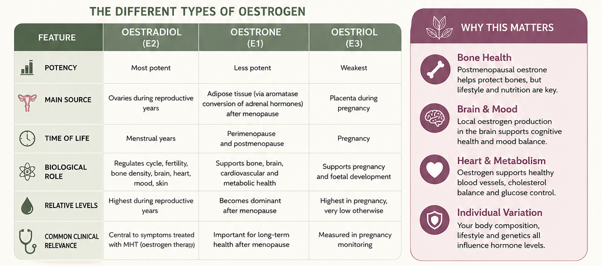
There are three main forms of oestrogen naturally produced in women:
Oestradiol (E2) is the most potent and biologically active form. During the reproductive years, it is primarily produced by the ovaries and plays a central role in regulating the menstrual cycle, fertility, bone density, brain function and cardiovascular health.
Oestrone (E1) becomes the dominant oestrogen after menopause. Although it is less potent than oestradiol, it continues to provide important biological effects.
Oestriol (E3) is the weakest form of oestrogen and is produced in significant amounts during pregnancy by the placenta.
Oestrogen is still produced in other tissues
Following menopause, the ovaries dramatically reduce oestrogen production. However, the body continues to manufacture small amounts of oestrogen in other tissues. The primary source becomes adipose (fat) tissue, where the enzyme aromatase converts adrenal hormones—particularly androstenedione—into oestrone. Smaller amounts are also produced within the adrenal glands, skin, liver, muscle, brain, blood vessels, breast tissue and bone, where oestrogen often acts locally within those tissues.
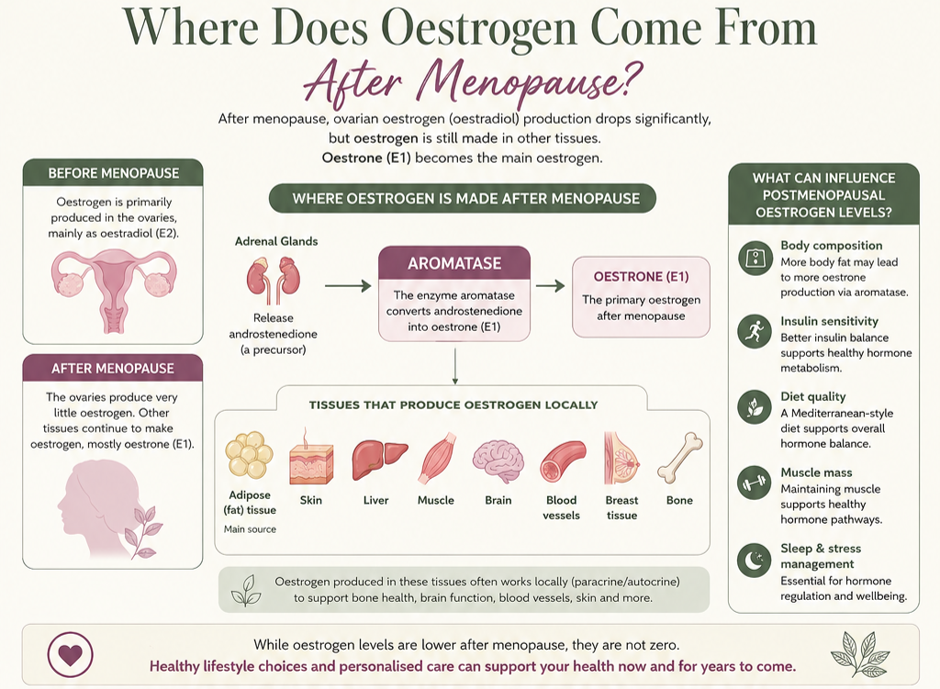
This shift helps explain why body composition can influence hormone levels after menopause. Women with more body fat may produce slightly more oestrone, although this does not necessarily translate into better health, as excess visceral fat is associated with increased inflammation, insulin resistance and higher risks of cardiovascular disease and some hormone-sensitive cancers.
Evidenced-based strategies as oestrogen production declines
While natural oestrogen production declines, there are many evidence-based strategies that can support healthy ageing during and after menopause. Regular resistance exercise, maintaining muscle mass, achieving a healthy body composition, consuming adequate protein, eating a Mediterranean-style diet, prioritising sleep and managing stress all contribute to better bone, brain and cardiovascular health.
For some women, menopausal hormone therapy (MHT) may also be appropriate following an individual assessment with their healthcare practitioner.
Understanding how your hormones continue to work after menopause empowers you to make informed decisions that support both symptom management and long-term wellbeing.
Wondering how your hormones are changing during perimenopause or menopause?
A personalised consultation can help you understand your symptoms, interpret your hormone changes and develop an evidence-based plan that supports your health now and into the future. Book a telehealth consultation today and take the first step towards feeling informed, confident and in control.
References:
The Menopause Society. The Menopause Society Position Statement: Hormone Therapy. Menopause. 2022;29(7):767-794.
Australasian Menopause Society. Information Sheets: Physiology of Menopause and Menopausal Hormone Therapy.
Endocrine Society. Endocrine Reviews. Estrogen physiology and metabolism.
Nelson HD. Menopause. The Lancet. 2008;371:760-770.
Simpson ER. Sources of oestrogen and their importance. The Journal of Steroid Biochemistry and Molecular Biology. 2003;86:225-230.
Labrie F. Intracrinology and local formation of sex steroids in peripheral tissues. Endocrine Reviews. 2015;36(4):400-450.
Santen RJ, et al. Postmenopausal oestrogen production and aromatase physiology. The Journal of Clinical Endocrinology & Metabolism. 2020;105(9):e3280-e3293.