
Menopause and dental health: how oestrogen changes can affect your teeth and gums
Hot flushes, sleep changes, weight gain and declining bone density are well-recognised features of the menopause transition. But there is another area of women's health that receives far less attention: our teeth and gums.
Changes associated with menopause and ageing may affect the gums, saliva, oral tissues and the bone supporting our teeth. Emerging evidence suggests that postmenopausal women may experience greater periodontal inflammation, probing depth and loss of attachment than premenopausal women, although researchers emphasise that the evidence is still evolving.
Gum disease in menopause: from gingivitis to periodontitis
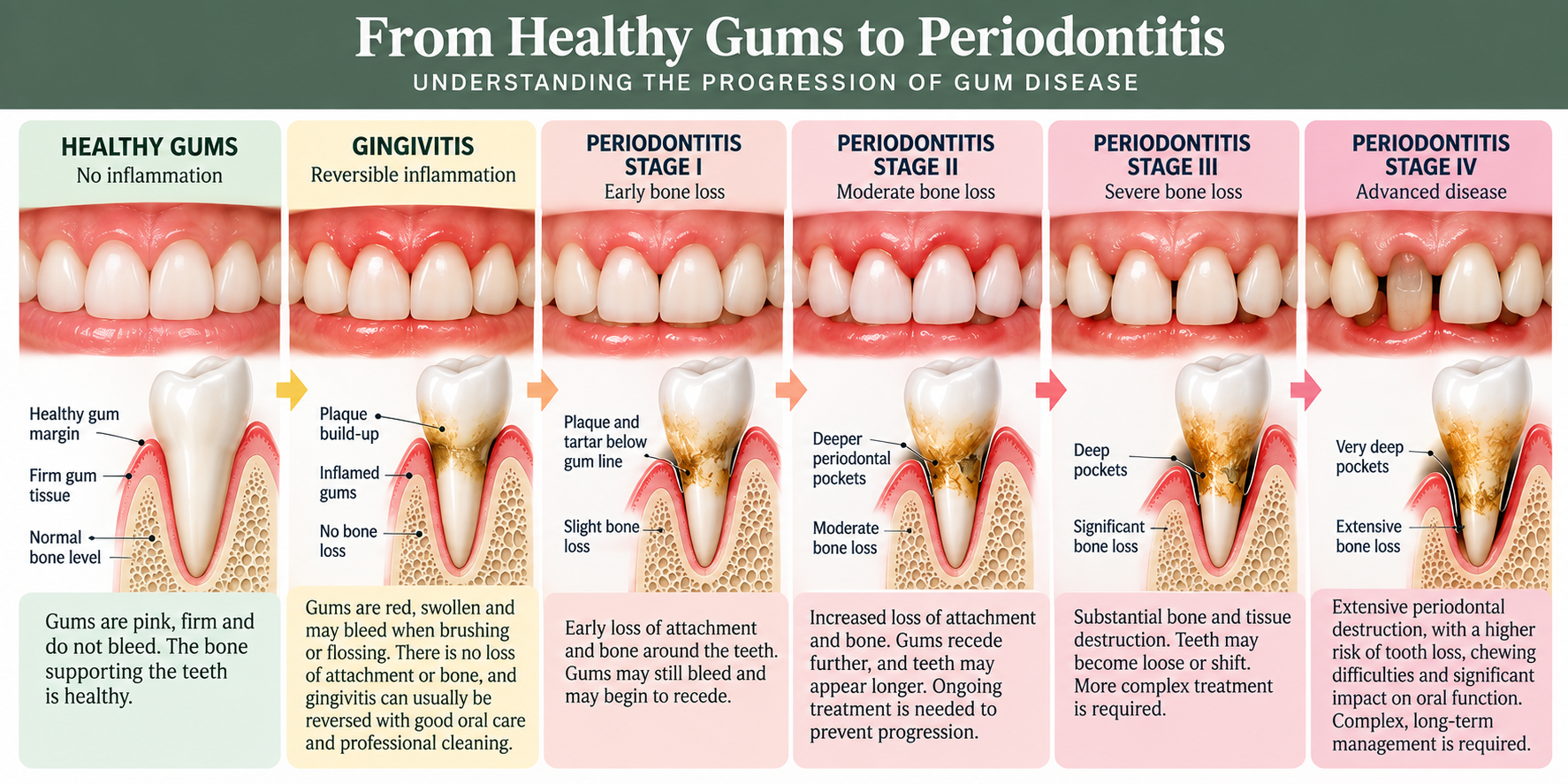
Periodontal disease doesn't necessarily begin with loose teeth. It can start much more subtly. Gingivitis is inflammation of the gums, commonly associated with dental plaque. Signs can include red or swollen gums, bleeding when brushing or flossing, tenderness and bad breath.
Importantly, gingivitis does not involve the attachment or bone loss seen with periodontitis and can generally be reversed when the inflammation is effectively managed.
If inflammation progresses into the deeper supporting structures around the teeth, periodontitis can develop. Unlike gingivitis, the attachment and bone loss associated with periodontitis is irreversible, although treatment can stabilise the disease and help prevent further progression.
Periodontitis is classified into four stages:
Stage I – initial periodontitis: early attachment and bone loss
Stage II – moderate periodontitis: greater attachment and bone loss, although tooth loss has not yet occurred because of periodontitis
Stage III – severe periodontitis: substantial tissue and bone destruction, potentially with tooth loss and greater complexity of treatment
Stage IV – advanced periodontitis: extensive periodontal destruction with the potential for significant tooth loss and problems with chewing and maintaining the dentition
Dentists also grade periodontitis to help assess its likely rate of progression and individual risk factors.

How does menopause affect your teeth and gums?
Changes in oestrogen across the menopause transition may influence the oral environment, including saliva, periodontal tissues, alveolar bone and inflammatory responses.
The hormonal and physiological changes accompanying menopause may influence inflammatory responses and periodontal tissues, while ageing, smoking, diabetes, medications, oral hygiene and other health factors can also contribute.
A recent systematic review found greater clinical attachment loss, probing depths and inflammatory signs in postmenopausal compared with premenopausal women. However, the certainty of the available evidence was rated moderate to low, so menopause should be considered one potential influence rather than the sole cause of periodontal disease.
Menopause may also be associated with changes in saliva and dry mouth (xerostomia). Because saliva helps protect teeth, lubricate oral tissues and buffer acids, persistent dry mouth can potentially increase vulnerability to tooth decay and oral discomfort.
Genetics may also influence an individual's susceptibility to periodontitis. Research suggests that a meaningful proportion of variation in periodontitis risk is heritable, with genetic influence appearing particularly important in more severe disease. Rather than there being a single ‘gum disease gene’, multiple genetic variants may influence how the immune and inflammatory systems respond to bacteria within the oral microbiome.
Genetics does not mean that periodontitis is inevitable; oral hygiene, smoking, diabetes and blood glucose control, ageing and other environmental and lifestyle factors remain important. This may help explain why some people develop significant periodontal disease while others with apparently similar exposures do not.
Menopause, periodontitis and osteoporosis: the bone health connection
After menopause, declining oestrogen contributes to accelerated bone loss and an increased risk of osteopenia and osteoporosis. We often think about the spine and hips when discussing osteoporosis, but our teeth are also supported by bone.
A 2023 systematic review and meta-analysis involving 28 studies and 19,611 women found that postmenopausal women with osteoporosis had poorer measures of periodontal health, including greater clinical attachment loss, probing depth, gingival recession and bleeding on probing.
This doesn't prove that osteoporosis causes periodontitis, but it reinforces the importance of considering oral and bone health together as women age.
Gum disease and cardiovascular health: is there a connection?
Perhaps one of the most interesting areas of research is the relationship between periodontal and cardiovascular health. Periodontitis is a chronic inflammatory disease. Periodontal bacteria and their products can enter the circulation, while periodontal inflammation can contribute to systemic inflammatory signalling. Research has identified an association between periodontitis and cardiovascular disease, with inflammation and bacteraemia among the proposed biological mechanisms.
This doesn’t mean gum disease directly causes heart disease. Both conditions share important risk factors, and their relationship is complex. However, international periodontal and cardiovascular experts recommend that oral health should be considered as part of cardiovascular preventive care.
Protecting your teeth and gums during menopause and beyond
Bleeding gums shouldn't simply be dismissed as a normal part of ageing. Regular dental and periodontal assessments, twice-daily brushing, interdental cleaning, not smoking, managing blood glucose and cardiovascular risk factors, and addressing persistent dry mouth can all contribute to maintaining oral health.
If you are approaching or moving through menopause, particularly if you also have osteopenia, osteoporosis, insulin resistance, diabetes or cardiovascular risk factors, your dental health deserves a place in the broader conversation about healthy ageing.
We routinely talk about protecting our heart, bones and metabolic health after menopause. Perhaps it's time we included our gums and teeth in that conversation too.
Take a proactive approach to your health through menopause
Menopause is about much more than managing hot flushes. Changes in bone health, metabolic health, cardiovascular risk and oral health can all become increasingly important during this stage of life.
If you're experiencing changes during perimenopause or menopause and would like to take a more comprehensive look at your health, I offer personalised naturopathic consultations that consider your symptoms, medical history, pathology, medications, nutrition and lifestyle.
Book a consultation to take a proactive approach to your health through menopause and beyond.
References:
Labunet A, Objelean A, Kui A, Rusu L, Vigu A, Sava S. Oral manifestations in menopause—a scoping review. Medicina (Kaunas). 2025;61(5):837. doi:10.3390/medicina61050837.
Thomas N, Peters K, O'Reilly K, Sousa MS, George A. Oral health care among women in perimenopause or menopause: an integrative review. J Midwifery Womens Health. 2025;70(1):17–31. doi:10.1111/jmwh.13668.
Impact of menopause on clinical periodontal outcomes: a systematic review. Clinical Oral Investigations. 2026. doi:10.1007/s00784-026-06813-y.
Qi J, Chen J, Pang Y, et al. Association between periodontal disease and osteoporosis in postmenopausal women: a systematic review and meta-analysis. Heliyon. 2023;9(11):e20922. doi:10.1016/j.heliyon.2023.e20922.
Low bone density and periodontal disease in postmenopausal women: a systematic review and meta-analysis. 2026. doi:10.4103/jfmpc.jfmpc_1595_24.
Herrera D, Sanz M, Shapira L, et al. Periodontal diseases and cardiovascular diseases, diabetes, and respiratory diseases: summary of the consensus report by the European Federation of Periodontology and WONCA Europe. Eur J Gen Pract. 2024;30(1):2320120. doi:10.1080/13814788.2024.2320120.
Larvin H, et al. Periodontal disease and cardiovascular disease: umbrella review. BMC Oral Health. 2024. doi:10.1186/s12903-024-04907-1.
Tonetti MS, Greenwell H, Kornman KS. Staging and grading of periodontitis: framework and proposal of a new classification and case definition. J Periodontol. 2018;89(Suppl 1):S159–S172. doi:10.1002/JPER.18-0006.
Chapple ILC, Mealey BL, Van Dyke TE, et al. Periodontal health and gingival diseases and conditions on an intact and a reduced periodontium: consensus report of Workgroup 1 of the 2017 World Workshop on the Classification of Periodontal and Peri-Implant Diseases and Conditions. J Clin Periodontol. 2018;45(Suppl 20):S68–S77. doi:10.1111/jcpe.12940.
Gao C, Iles M, Larvin H, et al. Genome-wide association studies on periodontitis: a systematic review. PLoS One. 2024;19(9):e0306983. doi:10.1371/journal.pone.0306983.
Nibali L, Bayliss-Chapman J, Almofareh SA, Zhou Y, Divaris K, Vieira AR. What is the heritability of periodontitis? A systematic review. J Dent Res. 2019;98(6):632–641.