
Burning when you urinate, repeated toilet trips and bladder pressure can leave you feeling miserable during a urinary tract infection (UTI). Women can experience UTIs at any age and understanding the triggers, recognising symptoms and choosing appropriate treatment options can help protect your urinary health.
What is a UTI?
A UTI develops when microorganisms, usually bacteria, multiply in the urinary tract (urethra, ureters, bladder or kidneys). Most bladder infections involve E. coli from the bowel travelling through the urethra and when the bacteria attaches in the urinary tract, it triggers inflammation.
UTI is a broader term used for infection anywhere in the urinary tract. Cystitis on the other hand refers to inflammation of the bladder, often caused by a bladder UTI, although it can occur without infection. A UTI that reaches the kidneys is called pyelonephritis and needs urgent medical care.

Who is at risk of developing a UTI?
Women have a shorter urethra which makes it easier for bacteria to reach the bladder and the risk can change throughout a woman’s life cycle:
Girls: Constipation, holding urine and urinary tract abnormalities can contribute
Younger women: sexual activity, spermicides and diaphragms increase risk
Pregnancy and after childbirth: changes in urinary drainage, incomplete emptying and catheter use can contribute. Pregnancy requires prompt medical assessment
Perimenopause and postmenopause: lower oestrogen affects urinary tissues and protective vaginal Lactobacillus bacteria
Later life: prolapse, incomplete bladder emptying and catheter use become more relevant
Diabetes, urinary stones, reduced immune function and a history of previous UTIs can increase the risk. Recurrent UTIs are classified as two infections within a six-month period or three within a year.
What are the symptoms of a UTI?
Common symptoms include:
Burning or stinging when urinating
Increased urgency
Frequent small urinations
Lower abdominal discomfort
Urine may look cloudy, smell different or contain blood. Odour or cloudiness alone does not establish infection though. Vaginal irritation, sexually transmitted infections and menopausal tissue changes can also mimic a UTI.
How are UTIs diagnosed?
Assessment typically starts with the symptom picture. A quick urine dipstick test can look for signs of infection i.e. white blood cell activity and nitrites. When needed, a urine sample can be sent to a laboratory to identify the bacteria responsible for the infection so the right antibiotic can be prescribed.
Pharmaceutical treatments for UTIs
Antibiotics such as nitrofurantoin (1st line), fosfomycin, trimethoprim or cefalexin may be prescribed according to individual circumstances. Eligible women can now also access assessment and treatment through participating Australian pharmacies. To ease discomfort, paracetamol and gentle warmth may help.
Hiprex (methenamine hippurate) helps prevent recurrent UTIs after an active infection has been treated. It releases antibacterial formaldehyde in acidic urine. The ALTAR trial supported it as an alternative to daily preventive antibiotics in some women.
Ural is a urinary alkaliniser used for short-term relief of burning or stinging when urinating. It raises the pH of urine, making it less acidic, which may ease discomfort. However, Ural does not eliminate the bacteria causing a UTI and does not replace antibiotics when these are needed. It should not be combined with Hiprex because alkalinising the urine reduces Hiprex’s effectiveness. It should also be avoided while taking nitrofurantoin, as it may reduce the antibiotic’s activity.
Complementary medicines for UTIs
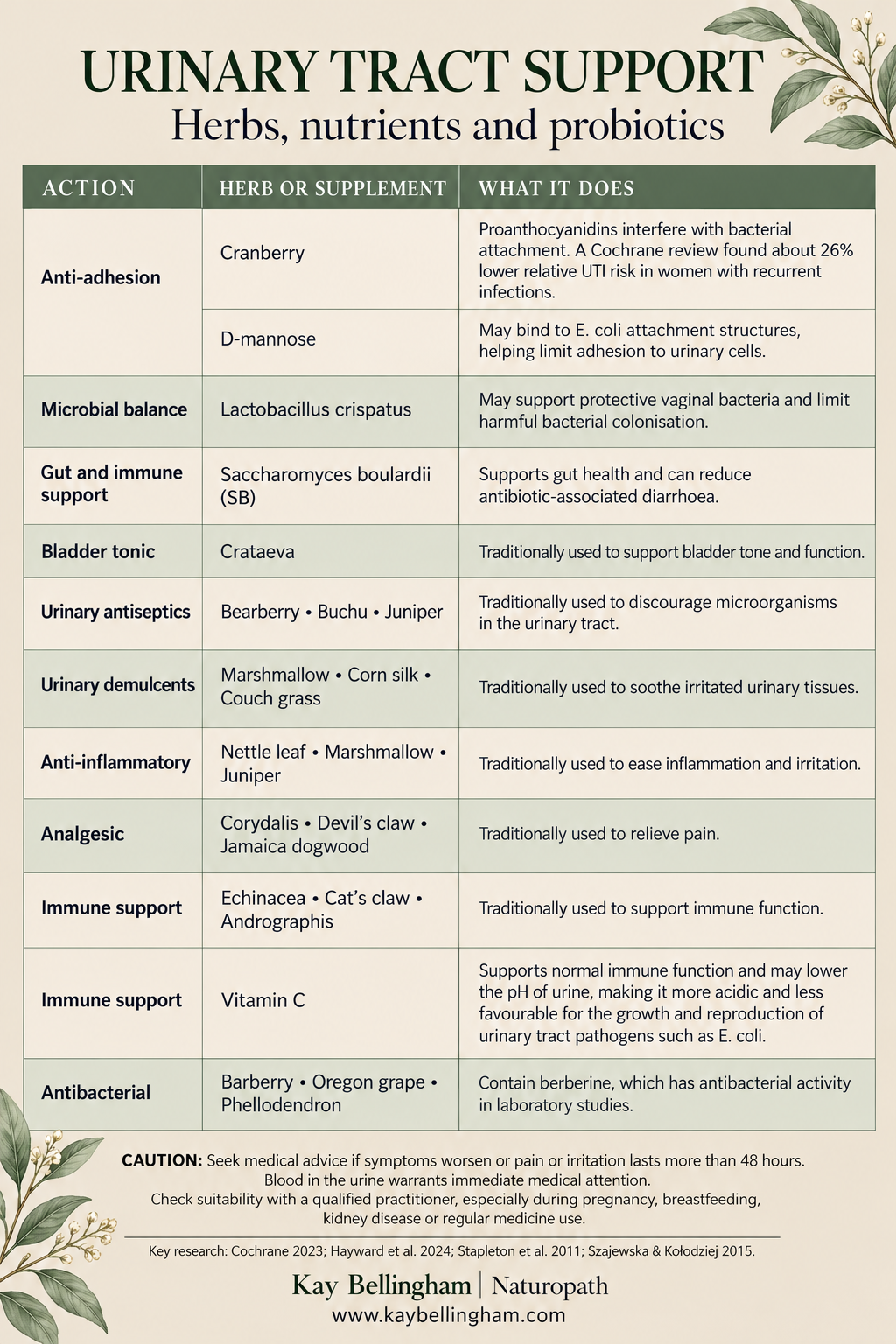
Complementary medicines, including herbs, nutrients and probiotics can support urinary tract health and target different areas of concern and support symptom relief:
How can you reduce the risk of recurring UTIs?
Drink adequate water, avoid repeatedly delaying urination, address constipation and bladder-emptying difficulties and avoid spermicides if they trigger infections. Increasing water intake reduced recurrences in a trial of premenopausal women who previously drank little water.
Drinking more water may seem counterintuitive when each trip to the toilet is uncomfortable. However, staying well hydrated supports urine flow, helping to flush bacteria out of the urinary tract.
Avoid perfumed intimate washes, reduce caffeine or alcohol if these aggravate irritation and wear breathable natural fabrics to promote airflow. Vaginal oestrogen can help prevent recurrent UTIs around and after menopause.
When should you seek medical advice for a UTI
Seek advice promptly for a suspected UTI. If symptoms become more severe, or pain or irritation persists for more than 48 hours, medical advice is recommended. The presence of blood in the urine warrants immediate medical attention. Fever, chills, back or side pain, vomiting or feeling very unwell require urgent care because infection may involve the kidneys.
Personalised support for recurrent UTIs
UTIs keep returning? Book a telehealth consultation with Kay Bellingham to review your triggers, menopausal changes, medicines and complementary options to develop a prevention plan alongside your healthcare professional.
References:
Healthdirect Australia. Urinary tract infection (UTI): symptoms, treatment and prevention. Accessed 30 October 2026.
https://www.healthdirect.gov.au/conditions/kidney-and-urinary-problems/urinary-tract-infection-uti
National Institute for Health and Care Excellence. Urinary tract infection (recurrent): antimicrobial prescribing. NICE guideline NG112. Updated 12 December 2024. Accessed 30 October 2026.
https://www.nice.org.uk/guidance/ng112/chapter/recommendations
Therapeutic Guidelines. Antibiotic updates: March 2025. Urinary tract infections in adults. Accessed 30 October 2026. Supports nitrofurantoin as first-line treatment for acute cystitis in adults, with individual suitability assessed.
https://www.tg.org.au/products/therapeutic-guidelines/updates/antibiotic/march-2025/
Harding C, Mossop H, Homer T, et al. Alternative to prophylactic antibiotics for the treatment of recurrent urinary tract infections in women: multicentre, open label, randomised, non-inferiority trial. BMJ. 2022;376:e068229.
https://doi.org/10.1136/bmj-2021-0068229
Stapleton AE, Au-Yeung M, Hooton TM, et al. Randomized, placebo-controlled phase 2 trial of a Lactobacillus crispatus probiotic given intravaginally for prevention of recurrent urinary tract infection. Clin Infect Dis. 2011;52(10):1212–1217. Product and route specific; the overall recurrence comparison was statistically inconclusive.
https://doi.org/10.1093/cid/cir183
Szajewska H, Kołodziej M. Systematic review with meta-analysis: Saccharomyces boulardii in the prevention of antibiotic-associated diarrhoea. Aliment Pharmacol Ther. 2015;42(7):793–801. Supports reduction of antibiotic-associated diarrhoea, not UTI prevention.
https://doi.org/10.1111/apt.13344
Williams G, Stothart CI, Hahn D, Stephens JH, Craig JC, Hodson EM. Cranberries for preventing urinary tract infections. Cochrane Database Syst Rev. 2023;11(11):CD001321. The recurrent-UTI subgroup in women had RR 0.74 (95% CI 0.55–0.99), approximately 26% relative risk reduction.
https://doi.org/10.1002/14651858.CD001321.pub6
Bone K, Mills S. Principles and Practice of Phytotherapy: Modern Herbal Medicine. 2nd ed. Churchill Livingstone; 2013. ISBN 9780443069925.