
Genitourinary syndrome of menopause (GSM): causes, symptoms and treatment options
Vaginal dryness, painful sex and recurring urinary discomfort can be unexpected consequences of menopause. Many women assume these changes are something they must tolerate, or repeatedly treat them as thrush or urinary infections.
Genitourinary syndrome of menopause (GSM) is common and treatable. Understanding the underlying changes helps women choose appropriate support, from vaginal moisturisers and prescription medicines, to carefully selected complementary options.
What is GSM?
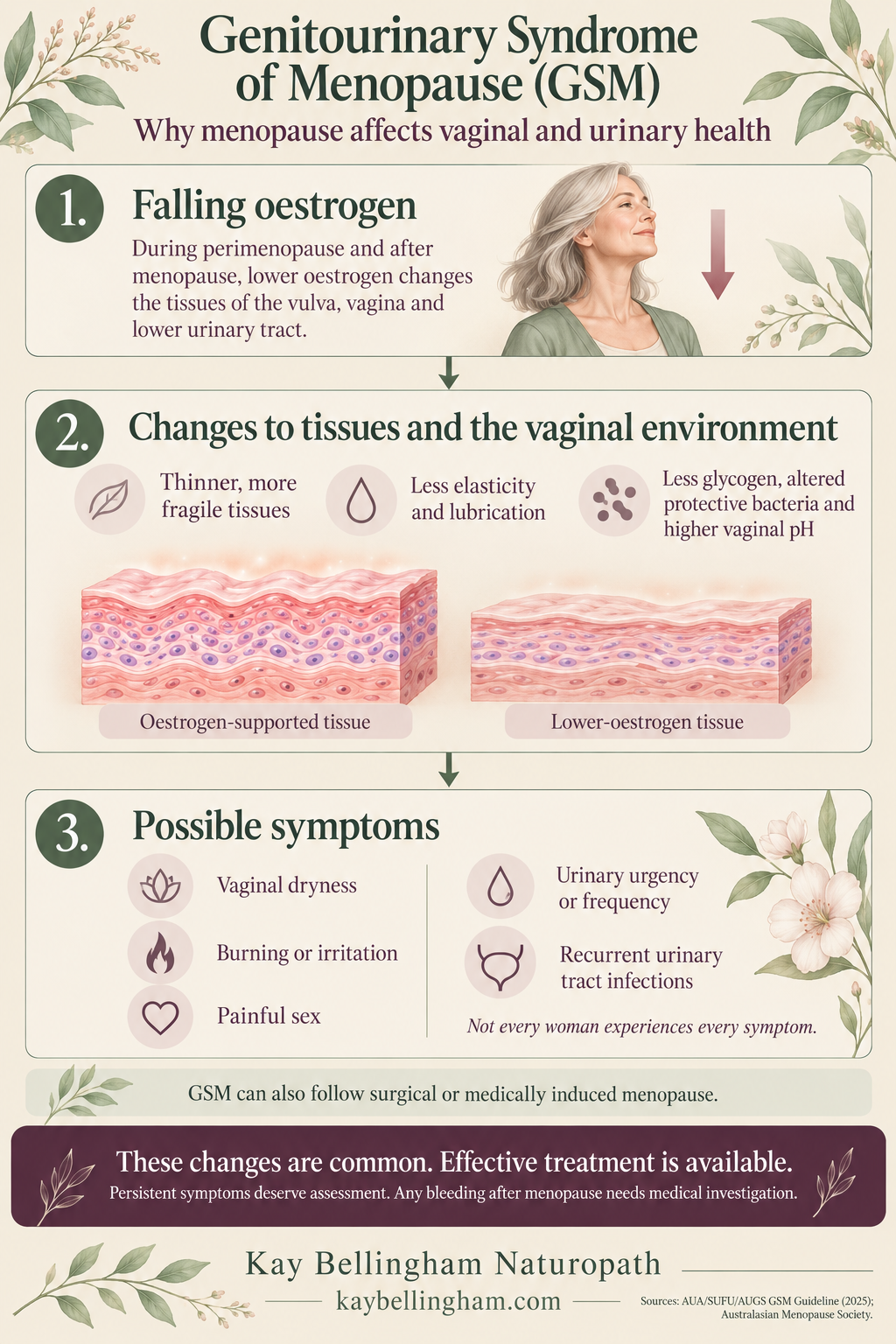
GSM describes changes affecting the vulva, vagina and lower urinary tract associated with declining sex hormones. Previously called vaginal atrophy or atrophic vaginitis, the newer term recognises that symptoms extend beyond vaginal dryness.
Symptoms may include burning, itching, reduced lubrication, pain during penetration, urinary urgency, frequent urination and recurrent urinary tract infections. These changes can affect everyday comfort, intimacy and quality of life. GSM can occur whether or not a woman is sexually active.

What causes GSM and who develops it?
Oestrogen helps maintain the thickness, elasticity and moisture of vaginal tissues. As levels decline, the vaginal lining becomes thinner and more fragile, with less lubrication. Changes also affect the vulva, urethra and bladder.
Reduced vaginal glycogen alters the environment supporting protective Lactobacillus bacteria, particularly Lactobacillus crispatus. Vaginal acidity decreases, meaning pH rises, which can contribute to changes in microbial balance. Declining androgen activity may also influence genital tissue health.
Symptoms can begin during perimenopause and become more prominent after menopause. Women experiencing early menopause, surgical removal of both ovaries or cancer treatments that reduce oestrogen may develop symptoms earlier or more abruptly. Unlike hot flushes, GSM often persists or progresses without treatment.
Which non-hormonal treatments help vaginal dryness?
Vaginal moisturisers are used regularly to improve hydration and comfort. Lubricants reduce friction during sexual activity, serving a different purpose and can be used alongside moisturisers.
Hyaluronic acid attracts and retains water. In a small 2024 randomised trial involving 49 women, vaginal hyaluronic acid and vaginal oestrogen both improved symptoms over 12 weeks. This supports hyaluronic acid as a promising non-hormonal option, although the pilot study does not establish equivalent effectiveness.
Avoiding douches, perfumed washes and irritating intimate products can reduce additional irritation. Pelvic floor physiotherapy may help when muscle tension contributes to painful penetration. Care should be tailored rather than automatically prescribing strengthening exercises.
Which medicines have clinical evidence for GSM?
Low-dose vaginal oestrogen has the strongest overall evidence base. Creams, vaginal tablets or pessaries deliver treatment directly to affected tissues, improving dryness and painful sex. Vaginal oestrogen can also reduce recurrent urinary infections associated with menopause. Systemic menopausal hormone therapy may not fully relieve GSM, so additional local treatment is sometimes needed.
Systemic absorption is generally low and a progestogen is usually unnecessary with recommended low-dose vaginal treatment. Women with previous hormone-sensitive breast cancer need individualised discussion with their treating team, particularly when taking aromatase inhibitors.
Other evidence-supported medicines include vaginal prasterone (DHEA), which is converted locally into sex hormones helping to improve vaginal dryness and or painful sex.
Can Sea buckthorn oil and complementary medicines help?
The fruit and seed of Sea buckthorn oil (Hippophaë rhamnoides) contains a balance of fatty acids, including omega-3, omega-6, omega-7 and omega-9. Omega-7 in particular helps to lock down the moisture barrier of the skin and mucous membranes so provides hydrating activity. Sea buckthorn oil is also highly nutritious (vitamin E, lutein, zeaxanthin, carotenoids, flavonoids) with potent anti-inflammatory and antioxidant activity.
A 2014 randomised, double-blind, placebo-controlled trial of 116 postmenopausal women experiencing vaginal dryness, burning or itching took 3g daily of a standardised blend of seed and berry oils, or placebo, for three months. Sea buckthorn oil significantly improved vaginal epithelial integrity, a measure of the condition of the vaginal lining, compared with placebo.
A small exploratory study in 2003 assessed 3g daily of oral Sea buckthorn oil for 12 weeks in five women with persistent vaginal inflammatory symptoms. Average combined symptom scores fell by 46%, with greater improvement in the three more severe cases. Oestrogen levels remained unchanged.
Sea buckthorn oil helps with many conditions associated with dryness.
Lactobacillus crispatus for GSM, Bacterial Vaginosis and Recurrent UTIs
The vaginal microbiome is different to that of the digestive microbiome. The vaginal microbiome has a low diversity of microorganisms and is dominated by Lactobacilli to help maintain a healthy vaginal pH.
In a small randomised study, adding oral Lactobacillus crispatus (20 billion CFU daily for 90 days) to vaginal CO₂ laser treatment increased vaginal L. crispatus abundance and improved selected symptoms, including burning, in postmenopausal women.
In a double-blind, placebo-controlled trial of 228 women, vaginal Lactobacillus crispatus following metronidazole (antibiotic and antiparasitic) treatment significantly reduced bacterial vaginosis recurrence at 12 weeks (30% versus 45% with placebo). These findings support this specific strain for reducing bacterial vaginosis recurrence after antibiotics.
In a placebo-controlled trial involving 100 premenopausal women, vaginal Lactobacillus crispatus following antibiotic treatment was associated with fewer recurrent UTIs (15% versus 27%), although the difference was not statistically significant.
When should you seek assessment?
Persistent symptoms deserve assessment to exclude infections, dermatitis and conditions such as lichen sclerosus. Any bleeding after menopause needs medical investigation. A personalised plan can combine appropriate local treatment, symptom support and ongoing review.
References:
Kaufman MR, et al. The AUA/SUFU/AUGS Guideline on Genitourinary Syndrome of Menopause. Journal of Urology. 2025;214(3):242–250. doi:10.1097/JU.0000000000004589.
Danan ER, et al. Hormonal treatments and vaginal moisturizers for genitourinary syndrome of menopause: a systematic review. Annals of Internal Medicine. 2024;177(10):1400–1414. doi:10.7326/ANNALS-24-00610.
Agrawal S, et al. A randomized, pilot trial comparing vaginal hyaluronic acid to vaginal estrogen for the treatment of genitourinary syndrome of menopause. Menopause. 2024;31(9):750–755. doi:10.1097/GME.0000000000002390.
Larmo PS, et al. Effects of sea buckthorn oil intake on vaginal atrophy in postmenopausal women: a randomized, double-blind, placebo-controlled study. Maturitas. 2014;79(3):316–321. doi:10.1016/j.maturitas.2014.07.010.
Australasian Menopause Society. Genitourinary Syndrome of Menopause. Information sheet.
Erkkola, R. I. S. T. O., & Yang, B. A. O. R. U. (2003). Sea buckthorn oils: towards healthy mucous membranes. Agro Food Industry Hi Tech, 14(3), 53-59.
Di Pierro, F., Filippini, M., Lucia, M., et al. (2026). Clinical and vaginal microbiota effects of oral Lactobacillus crispatus M247 combined with vaginal laser therapy in menopausal women with atrophic vulvovaginitis: A prospective, randomized and controlled study. Lasers in Medical Science, 41, 106. https://doi.org/10.1007/s10103-026-04900-w
Cohen, C. R., Wierzbicki, M. R., French, A. L., et al. (2020). Randomized trial of Lactin-V to prevent recurrence of bacterial vaginosis. New England Journal of Medicine, 382(20), 1906–1915. https://doi.org/10.1056/NEJMoa1915254
Stapleton, A. E., Au-Yeung, M., Hooton, T. M., et al. (2011). Randomized, placebo-controlled phase 2 trial of a Lactobacillus crispatus probiotic given intravaginally for prevention of recurrent urinary tract infection. Clinical Infectious Diseases, 52(10), 1212–1217. https://doi.org/10.1093/cid/cir183