
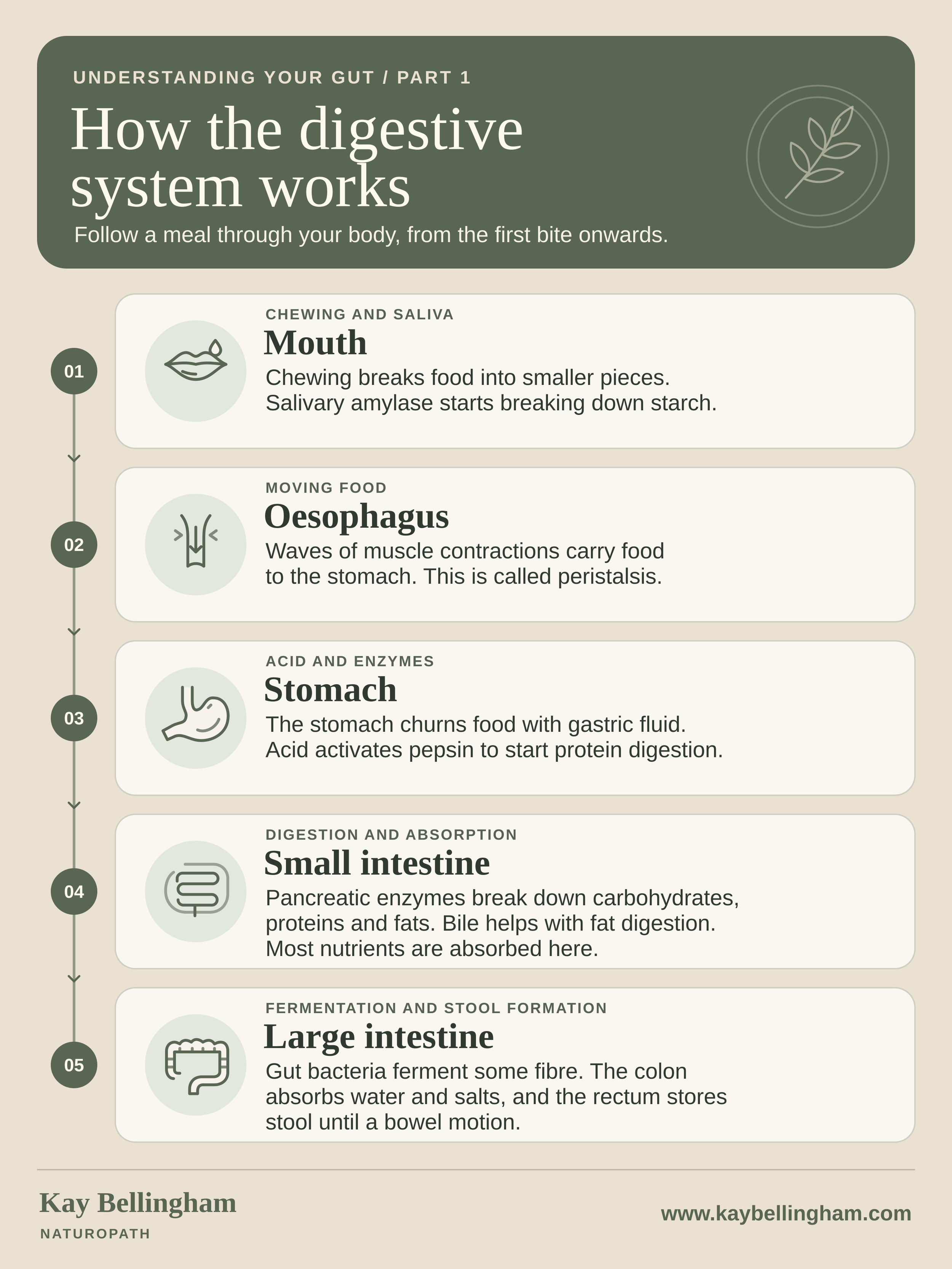
What happens to a meal after you swallow it? Your digestive system moves food along, breaks it down and absorbs the nutrients your body can use. Your stomach starts to digest protein, your small intestine does most of the work of digestion and nutrient absorption, and your large intestine helps turn what remains into a bowel motion.
Digestion starts in the mouth
Take a bite of toast. Your teeth break it into smaller pieces and mix it with saliva, which moistens the food and makes it easier to swallow. An enzyme in saliva called amylase begins carbohydrate digestion by breaking down complex carbohydrates such as starch into smaller sugars. Once you swallow, waves of muscle contractions carry the food down your oesophagus. This movement, called peristalsis, also helps push food and waste along the rest of the digestive tract.
The role of stomach acid
Your stomach holds the meal and churns it with gastric fluids. This fluid contains hydrochloric acid and substances released by glands in the stomach lining, including pepsinogen, the inactive form of the enzyme pepsin. The acid helps unfold proteins and converts pepsinogen to pepsin, which cuts the proteins into smaller pieces. Another enzyme, gastric lipase, starts breaking down some of the fat in your meal.
The stomach also releases intrinsic factor, a protein that helps you absorb vitamin B12 further along in the small intestine. At the same time, a layer of mucus and bicarbonate helps protect the stomach lining from acid and enzymes. The stomach gradually releases the resulting mixture, called chyme, into the duodenum, the first part of the small intestine.
How digestive enzymes and bile break down food
When chyme reaches the duodenum, bicarbonate from the pancreas helps neutralise the stomach acid. This gives pancreatic enzymes the conditions they need to work. Pancreatic amylase continues breaking down carbohydrates such as starch. Proteases such as trypsin and chymotrypsin break proteins into smaller pieces, and pancreatic lipase breaks down fats.
Bile helps with fat digestion too. The liver makes it, and the gallbladder stores it and releases it into the small intestine during a meal. Bile salts help disperse fat into tiny droplets, giving lipase more surface area to work on. Bile salts also help carry the products of fat digestion and fat-soluble vitamins such as vitamins A, D, E and K to the gut lining for absorption.
Some enzymes sit right on the surface of the small intestine. Lactase, for example, which breaks down lactose, the natural sugar in milk. If you have less lactase, more lactose can reach the large intestine, where bacteria ferment it. In some people, this can lead to wind, bloating or loose stools.
How the gut lining absorbs nutrients
The small intestine is lined with tiny finger-like projections called villi, which increase the surface area available for absorption. The cells covering each villus have even smaller projections called microvilli. Together they form the brush border, where enzymes such as lactase work and where nutrients are taken up. Sugars and amino acids pass into the blood and travel first to the liver, while most fats from a meal travel through the lymphatic system before reaching the bloodstream.
The lining also acts as a selective barrier. Cells are joined by structures called tight junctions, which help regulate what passes between them. Think of the cells lining your gut as two edges of fabric on a jacket. Tight junctions are like the teeth of a zipper, linking neighbouring cells and controlling what can slip between them. When the junctions work as they should, they allow small substances such as water and certain salts to pass in a controlled way. If the junctions become disrupted, more can slip through, much like a gap where the teeth of a zipper no longer line up.
That matters because the gut needs to selectively absorb nutrients while limiting contact between its other contents and the tissues underneath.
What happens in the large intestine
The large intestine, or colon, absorbs water and salts and helps turn what remains into stool. Gut bacteria ferment some of the fibre that reaches the colon. This produces gas and substances called short-chain fatty acids. One of these, butyrate, is an important fuel for the cells lining the colon. As stool moves towards the rectum, it becomes more formed. The rectum holds it until you’re ready to pass a bowel motion.
Common digestive symptoms
Bloating is the feeling of fullness or pressure. Distension is when your abdomen visibly expands. Fermentation can contribute, but so can constipation or a bowel that is especially sensitive to normal amounts of gas.
With constipation, slower movement through the colon means stools can spend longer in the colon. This gives the colon more time to absorb water, leaving stools harder and drier. Stool that builds up can also make your abdomen feel full, tight or bloated. Diarrhoea can occur when the bowel absorbs less water or releases more fluid than usual, as can happen with an infection.
If a change in your bowel habits persists or keeps coming back, speak with your health professional. Do the same if you notice blood in your stool or lose weight without trying.
In Part 2, we’ll look more closely at the gut lining, what changes when it becomes more permeable or when those ‘zippers’ are disrupted and what people mean by “leaky gut”.
References:
NIDDK. Your Digestive System & How It Works.
StatPearls. Physiology, Digestion. NCBI Bookshelf.
healthdirect Australia. Diarrhoea.