
Struggling to fall asleep, waking during the night or feeling exhausted despite spending enough time in bed? Sleep disturbances are common during the menopause transition, affecting around 40–60% of women during perimenopause and postmenopause. Hormone changes can contribute, but night sweats, stress, medical conditions and underlying sleep disorders often overlap. Understanding what is interrupting your sleep helps guide effective treatment.
Understanding sleep architecture: what happens while you sleep?
Sleep architecture describes the organisation of sleep into stages and cycles. Throughout the night, we move through non-rapid eye movement (NREM) and rapid eye movement (REM) sleep, usually completing four to six cycles lasting approximately 80–100 minutes each. Brief awakenings between cycles are normal.
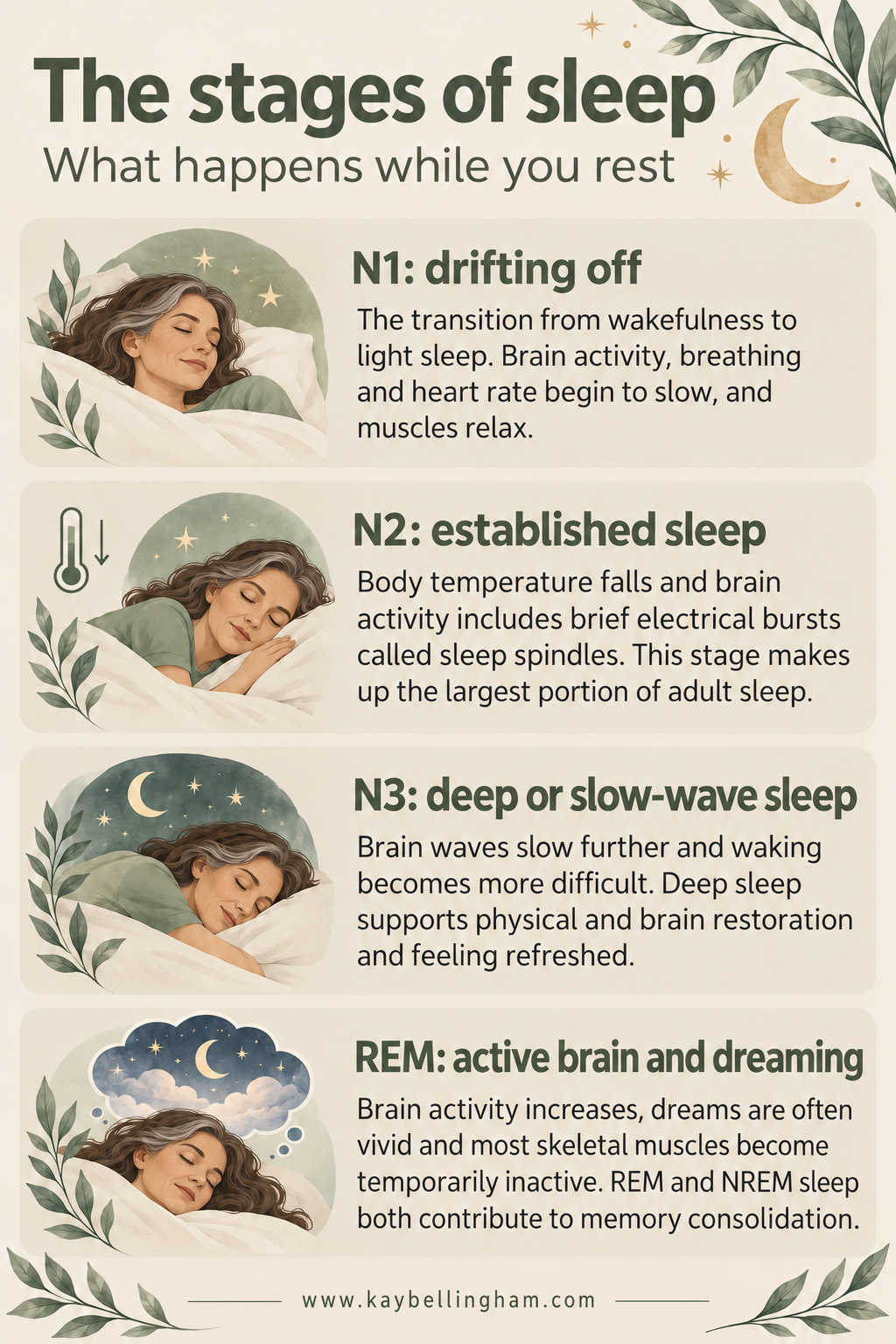
Deep sleep is concentrated earlier in the night, while REM periods become longer towards morning. Cutting sleep short can therefore reduce access to later REM sleep as well as total sleep time.
Sleep quality involves more than hours. It includes how readily you fall asleep, how often and how long you remain awake overnight and whether sleep leaves you feeling restored. Eight hours in bed may contain substantially less than eight hours of sleep.
Why does menopause compromise sleep?
Hormonal changes and night sweats
Fluctuating and declining oestrogen can affect temperature regulation and sleep–wake systems with progesterone changes also contributing to the changing hormonal environment. Hot flushes and night sweats can trigger awakenings, followed by difficulty cooling down or returning to sleep.
However, disturbed sleep can also occur without night sweats. Menopause does not produce one predictable change in sleep architecture for every woman and sleep-study findings are less consistent than women’s reports of worsening sleep. Ageing and other contributors need consideration.
Stress, mood and the “wide-awake” cycle
Work demands, caring responsibilities, anxiety and low mood can increase mental alertness at bedtime. After repeated poor nights, worrying about sleep itself can maintain insomnia even after the original trigger improves. Sleep and mood influence each other. Poor sleep can worsen emotional wellbeing, while anxiety and depression can interrupt sleep.
Sleep disorders, health conditions and daily habits
Other contributors include:
Obstructive sleep apnoea: repeated narrowing or closure of the airway. Risk increases after menopause; symptoms may include snoring, gasping, fatigue or insomnia
Restless legs and periodic limb movements: uncomfortable urges to move the legs or repeated movements that interrupt sleep
Pain and medical conditions: joint discomfort, reflux, bladder symptoms and thyroid disorders may disturb sleep
Medicines and substances: some medicines affect alertness or sleep; caffeine can delay sleep, while alcohol commonly fragments the second half of the night
Environment and timing: heat, noise, irregular schedules, screen time and evening light exposure can interfere with sleep
How much sleep do you really need?
Most adults need 7–9 hours of sleep each night, with individual variation. Menopause does not automatically reduce this need. Regularly waking unrefreshed or struggling to stay alert deserves attention, even when your recorded sleep duration appears adequate.
Sleep difficulties are also widespread across Australia. The 2016 Sleep Health Foundation national survey found that inadequate sleep and its daytime consequences affected approximately 33–45% of adults, depending on the measure used. Average reported sleep duration was seven hours. These are historical survey findings, rather than a current prevalence estimate.

What are the consequences of poor sleep?
Insufficient or fragmented sleep can affect concentration, memory, emotional regulation and reaction time, adding to the experience of menopausal “brain fog”. It may also make work, relationships and driving more difficult.
Persistent sleep deficiency can impair glucose regulation, influence appetite and immune function and is associated with higher risks of hypertension, cardiovascular disease, obesity and depression. These relationships are complex, but they reinforce the importance of treating ongoing sleep problems.
What helps improve sleep during menopause?
Treatment starts with the contributors. A consistent wake-up time, morning daylight, regular physical activity, a comfortable bedroom temperature and reducing afternoon caffeine and evening alcohol can help.
For persistent insomnia, cognitive behavioural therapy for insomnia (CBT-I) is a first-line treatment. It addresses the behaviours and thought patterns that maintain insomnia and offers more than general sleep-hygiene advice.
Where hot flushes and night sweats are driving awakenings, menopausal hormone therapy (MHT), when appropriate, prescribed non-hormonal treatment or complementary medicines may help. Sleep apnoea, restless legs, pain and mood disorders require their own assessment and management.
Melatonin, magnesium, Saffron, Passionflower and L-theanine: what does the evidence show?
Melatonin: supporting sleep timing
Melatonin is a hormone released by the pineal gland that signals biological night and helps coordinate the body clock. It may be useful for selected sleep-timing problems and some forms of insomnia, but it does not address every cause of night waking.
Menopause-specific results are uncertain: systematic reviews have not demonstrated a consistent improvement in sleep quality. In Australia, certain prolonged-release products are available through pharmacists for short-term primary insomnia in adults aged 55 and over, following assessment. Timing and formulation matter and more is not necessarily better.
Magnesium: a possible modest benefit
Magnesium supports normal nerve and muscle function and may also support the body’s own melatonin production. Correcting inadequate intake is worthwhile, but supplementation may not help every sleep problem.
A 2025 placebo-controlled trial involving 155 adults found that magnesium bisglycinate providing 250 mg elemental magnesium daily for four weeks produced a small improvement in insomnia severity.
Saffron: promising research for sleep and mood
Saffron (Crocus sativus) increases sleep quality, supports refreshing sleep and relieves sleeplessness.
Standardised saffron extracts, including affron®, have improved self-reported sleep outcomes in several small, short-term trials in adults with poor sleep. These findings apply to the studied extracts and cannot automatically be extended to all Saffron products.
A 2026 trial of 86 menopausal and postmenopausal women aged 50–70 tested 28 mg daily for 12 weeks. It found improvements in mood, anxiety and daytime impairment related to sleep with the majority of improvements seen at week four.
Passionflower: traditional use with emerging clinical evidence
Passionflower (Passiflora incarnata) has a recognised tradition of use for mild mental stress, anxiety and to aid sleep. The European Medicines Agency distinguishes this long-standing use from efficacy established through robust clinical trials.
In a two-week trial involving 110 adults with insomnia, Passionflower increased total sleep time by approximately 23 minutes compared with virtually no change on placebo.
L-theanine: emerging evidence for sleep support
L-theanine, an amino acid found in tea, has shown potential to support relaxation and aspects of sleep quality in adult clinical trials. A recent study in perimenopausal and postmenopausal women found that a combination containing L-theanine, GABA, magnesium and other ingredients improved reported sleep quality and duration. L-theanine may be considered where stress and difficulty winding down accompany sleep problems.
Complementary medicines can be selected based on your symptoms, health history and current medicines. The doses above describe research protocols, rather than individual recommendations.
When should you seek help for sleep problems?
Seek assessment if sleep difficulties persist, affect daytime functioning or occur alongside snoring, gasping or an uncomfortable urge to move your legs. Significant daytime sleepiness also warrants prompt review.
Struggling with sleep during perimenopause or postmenopause? A personalised consultation can explore your symptoms, nutrition, lifestyle and medication–supplement use, with GP or sleep-specialist collaboration where needed. Visit www.kaybellingham.com to book a telehealth consultation.
References:
Baker FC, Lampio L, Saaresranta T, Polo-Kantola P. Sleep and sleep disorders in the menopausal transition. Sleep Medicine Clinics. 2018;13(3):443–456. Full text.
Australasian Menopause Society. Menopause and sleep. Clinical information sheet.
National Institute of Neurological Disorders and Stroke. Brain basics: Understanding sleep. Patient resource.
Adams RJ, et al. Sleep health of Australian adults in 2016: results of the 2016 Sleep Health Foundation national survey. Sleep Health. 2017;3(1):35–42. Article.
A systematic review and meta-analysis of randomized controlled trials investigated the effects of melatonin supplementation on bone mineral density, quality of life, and sleep in menopausal women. 2026. Full text.
Schuster J, et al. Magnesium bisglycinate supplementation in healthy adults reporting poor sleep: a randomized, placebo-controlled trial. Nature and Science of Sleep. 2025;17:2027–2040. Full text.
Lopresti AL, et al. Effects of saffron on sleep quality in healthy adults with self-reported poor sleep: a randomized, double-blind, placebo-controlled trial. Journal of Clinical Sleep Medicine. 2020;16(6):937–947. Full text.
Lopresti AL, Smith SJ, Drummond PD. An investigation into an evening intake of a saffron extract (affron®) on sleep quality, cortisol, and melatonin concentrations in adults with poor sleep. Sleep Medicine. 2021;86:7–18. PubMed.
Lopresti AL, Smith SJ. The effects of a saffron extract (Affron®) on mood, sleep, self-esteem, and exploratory measures of physical appearance in women aged 50 to 70 years experiencing low mood and poor sleep. Frontiers in Nutrition. 2026;13:1838513. Full text.
Lee J, et al. Effects of Passiflora incarnata Linnaeus on polysomnographic sleep parameters in subjects with insomnia disorder: a double-blind randomized placebo-controlled study. International Clinical Psychopharmacology. 2020;35(1):29–35. PubMed.
European Medicines Agency. Passiflorae herba. Traditional-use reference for mild mental stress and aiding sleep. Herbal monograph and assessment.
Carbonneau S, Mysliwiec V, Doyle AL, et al. Nonsedating neurotransmitter-modulating supplement for nonvasomotor sleep disturbance in menopause. Menopause. 2026. Published online September 15. doi: 10.1097/GME.0000000000002880.